







Reducing Charge is Not a Compromise
– It’s a Design Choice
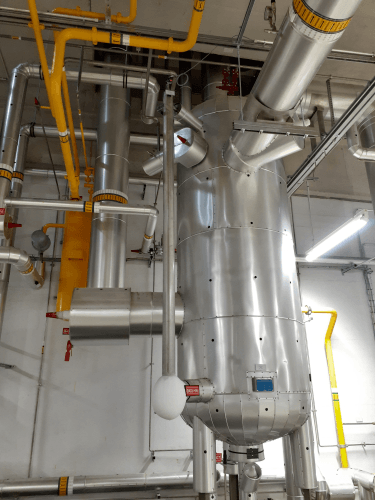
At a cold storage facility in northern Germany they faced a familiar problem:
How do you maintain stable operation when the system rarely runs at full load?
The system operated across three temperature levels:
- -42°C for blast freezing
- -32°C for cold storage
- -10°C for loading docks
With frequent partial load conditions, the risk is clear: Flooded evaporators. Wet suction lines. Reduced performance. The original solution was a traditional pumped overfeed system with an ammonia charge of 5 tonnes. That solution works. But it is not optimal.
A Different Approach
Instead of accepting the limitations, the operator chose a different path: Direct expansion with Vapor Quality Sensor just outside the evaporator.
With Vapor Quality Sensors, the system measures what actually matters: what is happening inside the pipe in real time. This enables precise control, compressor protection and eliminates the need for superheat control. It is not incremental improvement. It is a different level of control.
To dive into some of the myths and common misunderstandings regarding the use of ammonia in DX designed refrigiration systems, check out this article by our founder Michael Elstrøm. In this, he adresses risks and provides concrete recommendations based on experiences from well-functioning and ennergy efficient systems.
Reducing Refrigerant Charge
By moving from a pumped overfeed system to a DX system with sensor-based control:
- Ammonia charge reduced from 5 tonnes to 2.2 tonnes
- System complexity reduced
- Operational stability improved
This is not a marginal gain. It is a fundamental change in system design.
Energy Performance
After two years of operation: - 36 kWh/m³/year vs 47 kWh/m³/year
This corresponds to a 24% reduction in energy consumption. These results were achieved under real operating conditions across all temperature levels (-42°C / -32°C / -10°C).
|
Ammonia charge |
Energy reduction |
Temperature levels |
Conclusion
You can run a traditional system. Or you can control the process.
The result: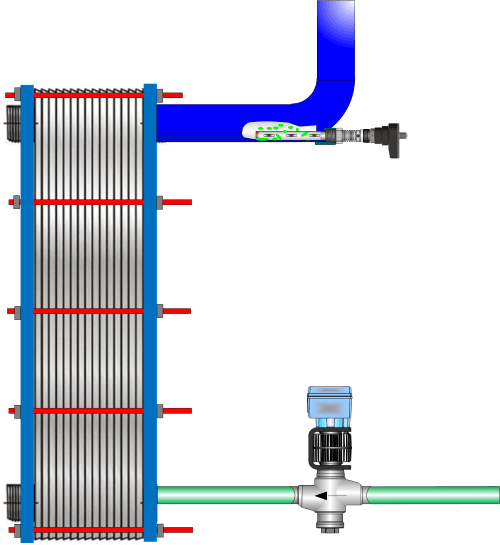
- Lower charge
- Lower energy consumption
- More stable operation
Not by adding complexity, but by measuring what actually matters.
Control is only as good as the data you rely on.
Interested in learning more about the Vapor Quality Sensor?
Read more